Federal Center, Chicago, Mies van der Rohe (Photographed by me at the MoMA, NY)
I worked on a studio project once with a German exchange student whos drawings looked a lot like this. He was very smart and I liked him, but he was not an overachiever or a workaholic. He kept things simple in part because it was easier that way. On the other hand you’d probably say that Mies showed remarkable restraint and that to achieve minimalism he spent long hours honing things down to the barest essence, making all the parts speak together in unison with no part left unconsidered. Less is More.
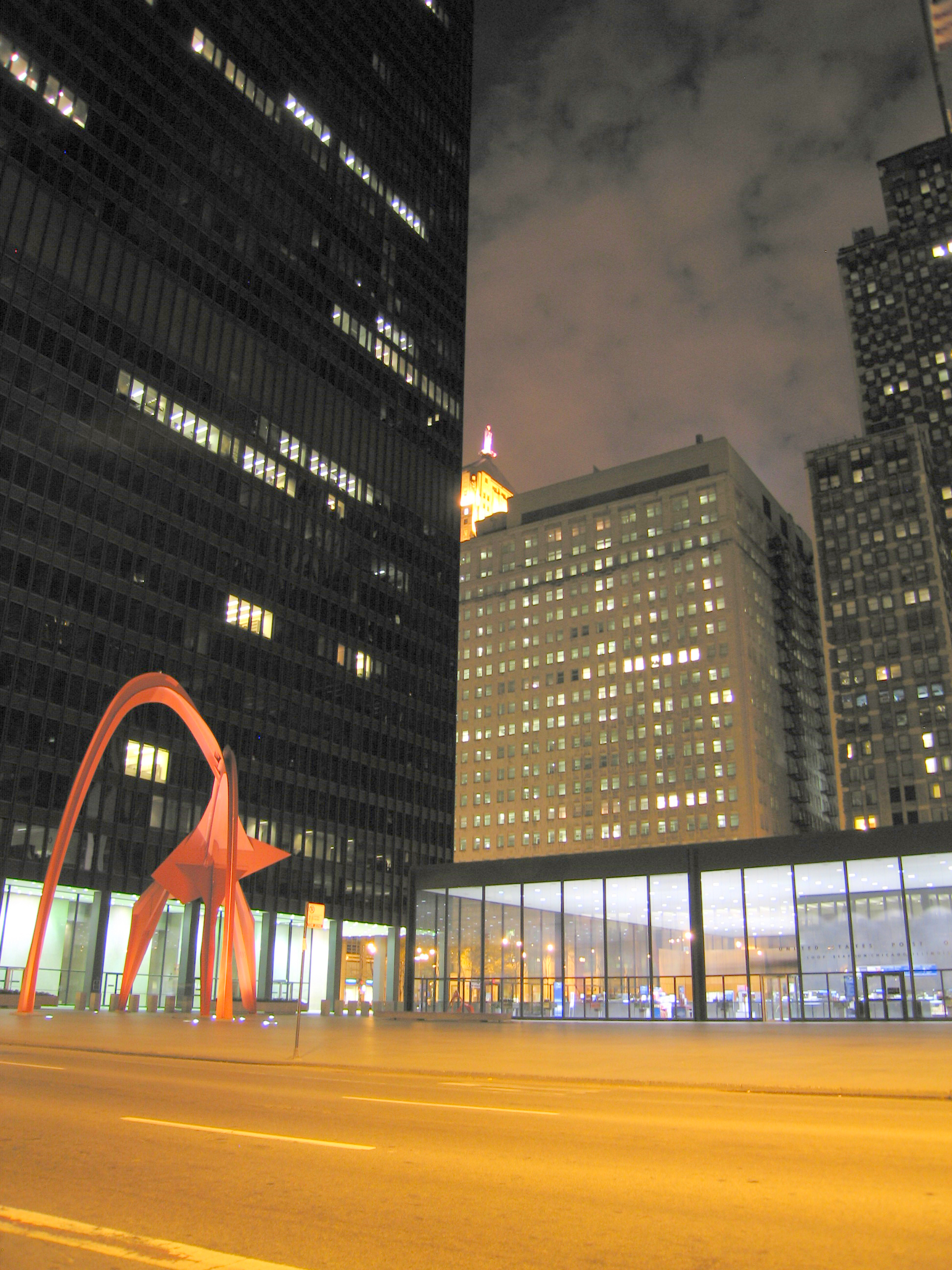
I took this photo of the same building (to left) a few years ago. Minimalist buildings make a nice backdrop for the colorful Calder sculpture.
I enjoyed watching this video of life in a 12’x12′ cabin with no hot water, electricity, internet, and heated by fireplace. In exchange for giving up these modern amenities, the occupants get peace, quiet and a simple life. Not a life for everyone, but perhaps we all can take something from this example. The cabin itself is also very well designed and built.
My friend Amanda installed this Marmoleum floor in her laundry room. I think the color choice is great in this small, mostly white room. It might be a bit busy in a bigger room with more colors, objects, and activity. Marmoleum is a great product – It is old fashioned linoleum made from “linseed oil, rosins, wood flour, jute and ecologically responsible pigments.” It comes in a wonderful array of colors…most are subtly speckled so dirt and crumbs and scratches don’t show so much.
The internet seems to like our small studio. I have found many repostings of Lenny’s photos, and commentary about the little studio. Most of them seem to have just nabbed and revised slightly the written content from Dwell or the Washington Post, but here are a few that are more original:
Yesterday Kirsten Dirksen and Nicolas Boullosa came all the way from Barcelona to make a video about the studio. I eagerly and nervously await my and John’s debut as movie stars on faircompanies.com.
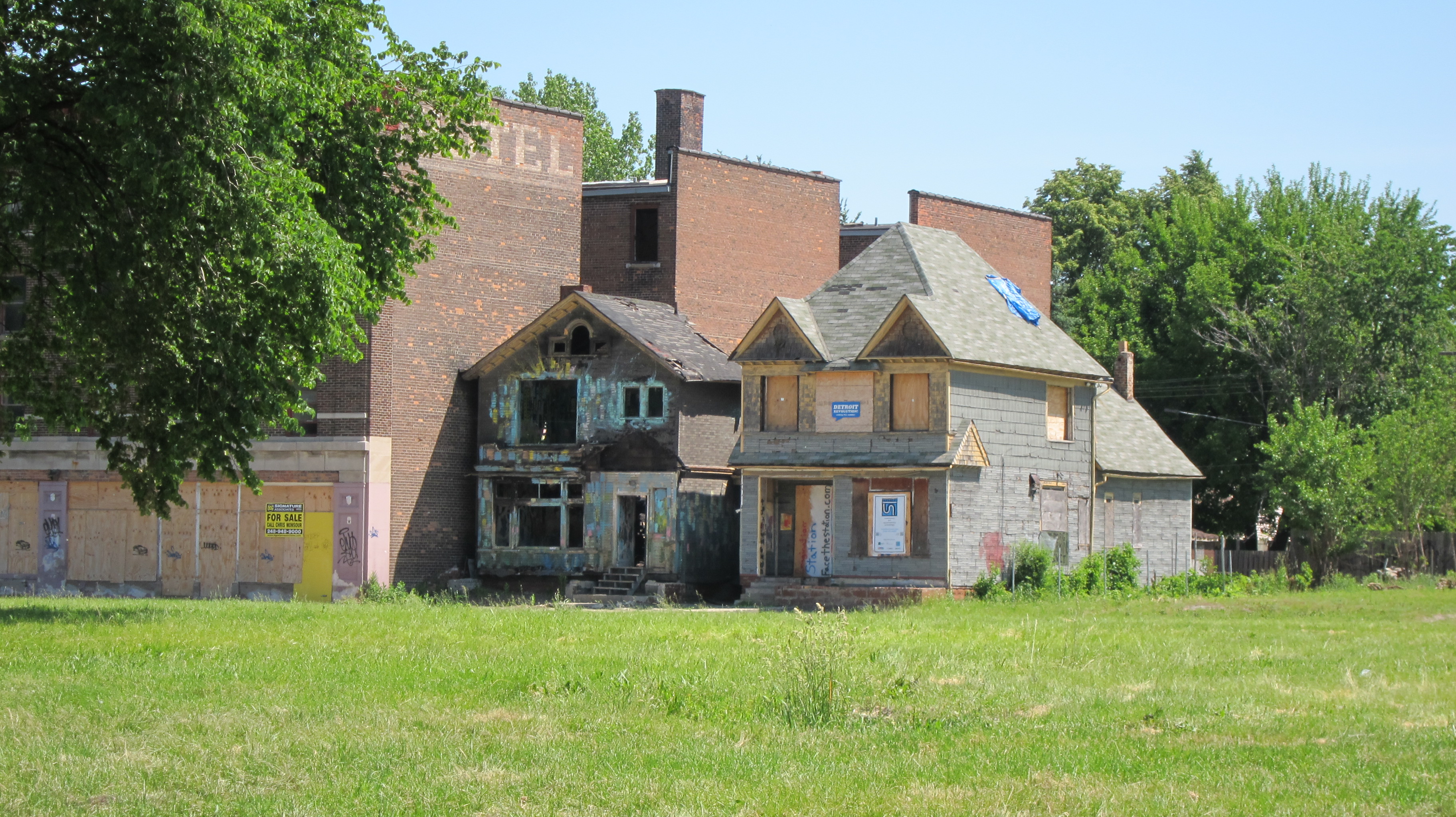
I received this hefty book for Christmas from my dad. It contains a lot of great photos of the city I grew up near. Enclosed in the pages of the book was this New Yorker article about the book and its forward written by Elmore Leonard, also a native of suburban Detroit. It is mentioned in the article and forward that “Julia believes it should be preserved and appreciated any way it is, not restored.” Urban decay is beautiful, I agree, but honestly it seems like an insensitive statement from a resident of Bloomfield Hills. You could call her a poverty tourist. I know for a fact that many Detroiters are annoyed by all the hipsters from Europe who come in droves to photograph the urban blight. But in some ways I am inclined to agree with the author. (I too have the privilege of viewing the city from afar and on occasional visits home to another affluent suburb.) The people of Detroit deserve our compassion and it is sad to see some truly beautiful old buildings fall into unsalvagable disrepair, but at this point it might not be all bad to allow the city to slowly return to nature.
The New Yorker Article ends with reference to Elmore Leonard’s teasing attention to the origin of the holes in Julia Taubman’s jeans.
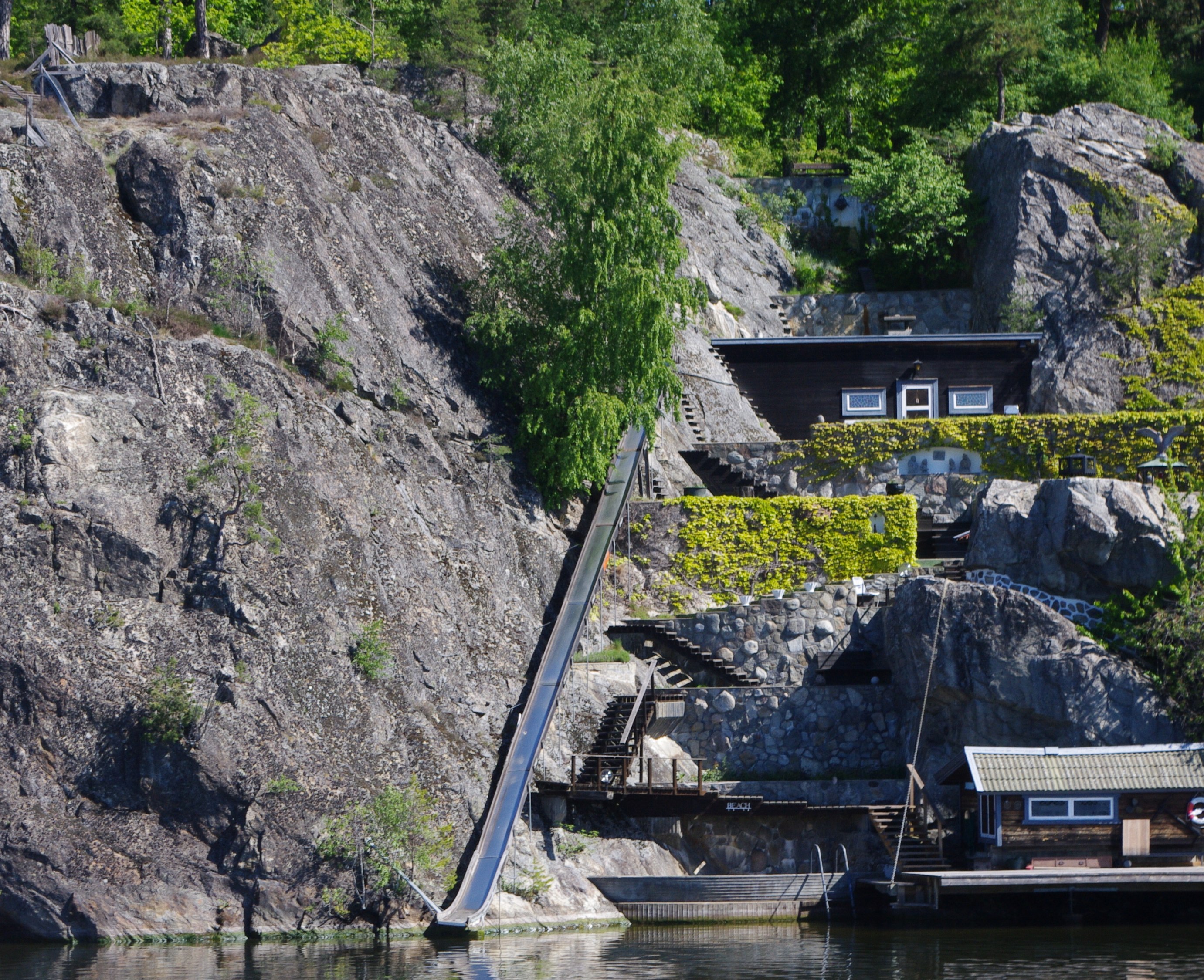
My friend Charles shared this photo he took from a boat tour near Stockholm. The house looks like its built right into the rocks. Clean minimal lines, stone walls that blend with the cliffs, subtle earthtones, black painted wood, and a very tasteful waterslide.
I saw these blocky interlocking bottles at the MoMA, NYC, designed by Juris Mednis in 1983. What a great way to package shampoo and conditioner….ketchup and mustard….oil and vinegar.
Michelle Bachmann’s house with “a grand manor roof” and “European flavor”
Gingrich’s “Mansionette”
Santorum House: “a big rectangular box with holes punched in it for windows. It doesn’t have much to say. Need I say more?”
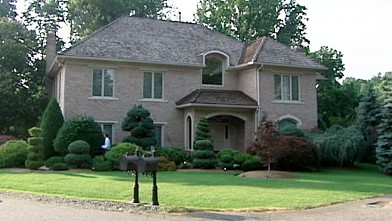
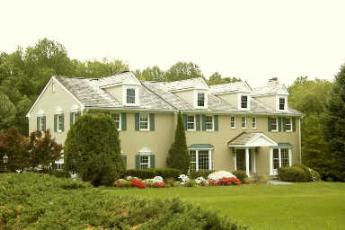
The New York Times ran this article recently about the homes of the Republican presidential candidates. The review, informed by “interior designers and design psychologists” (no architects) is generally unfavorable. They make fun of Newt Gingrich’s extensive use of mirrors and Huntsman’s pink love seat with yellow bows. Bachmann’s complex roofline is rather atrocious (no mention of the maintenance issues with such a roof,) and Santorum’s more simple house is called boxy with small punched windows. The houses are all quite big… mostly around 5500 square feet. One designer who commented in the article said that he’d call them McMansions, but that would give McDonalds a bad name. Wow. That is saying a lot. None of them appear to be designed by architects that were given much latitude, but most of the candidates appear to have dropped some cash on interior designers. The houses all scream “I am a traditionalist,” according to design psychologists that were consulted. Manicured green lawns and brick or stone are present in all.
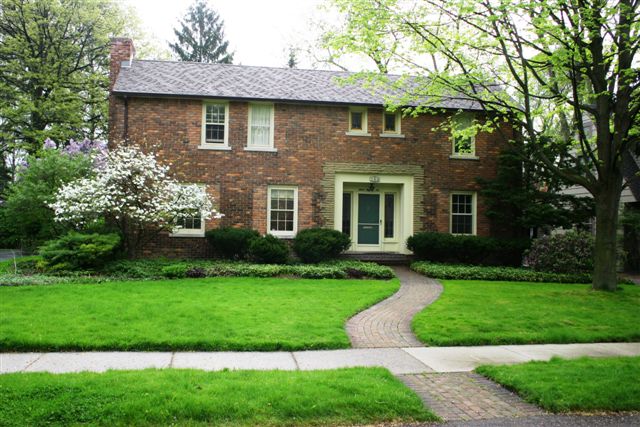
Uh Oh. What would they say about my parent’s house, (the house were I grew up)? My dad took off the fake shutters at least….and it does have industrial chic concrete window sills. The windows are true divided lites, by the way, and my folks hired a local artist to make some stained glass windows for either side of and above the front door…Its not so big, but it is brick veneer with a green lawn and small punched windows.
Not a Republican house though
There is no discussion in the Times article about solar orientation or energy efficiency. There is no mention of simplicity, elegance, or economy. Creativity does not make an appearance, (except in Newt’s whimsical topiary.)
Perhaps the candidates can learn a bit from Ice Cube.
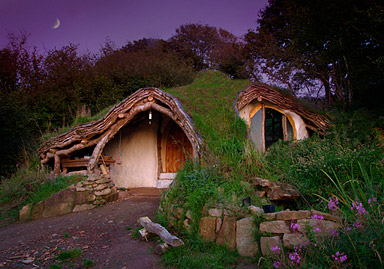
A young man in Wales built this house for his family using a chainsaw, a hammer and a 1″ chisel. In some ways I am more drawn to this one than the modular one….even though it makes for rustic living. He needed no team of architects, engineers, and modular specialists. It has no green certification, but certainly far greener, except for its location in the countryside. The modular house is more suited for modern urban lifestyles.
Thank you to my British correspondent, Amanda Soskin, for sharing this gem.
Lloyd Kahn has published several books about similar creative, owner built structures. Here is a glimpse of a recent Lloyd Kahn book that I have enjoyed very much.






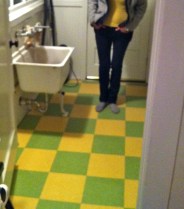 My friend Amanda installed this Marmoleum floor in her laundry room. I think the color choice is great in this small, mostly white room. It might be a bit busy in a bigger room with more colors, objects, and activity.










 deedsdesign