I stole this photo from the website of Fabrica718. It is an image taken with an infrared camera of a block of Brooklyn brownstones. The blue one is the one they remodelled….blue because its envelope is so well insulated that very little heat is escaping. Pretty cool. I’m not sure why most of the other houses have blue second and third story windows. I can’t imagine that the whole block has been upgraded to triple pane. Any ideas?
Archive for the ‘Information’ Category
Thermal Image of Tight House, NYC
Posted in Information, tagged energy efficiency, green, New York, thermal imaging camera on October 29, 2013| 2 Comments »
Underground Houses
Posted in Information, tagged appraisal, appraisals make me grumpy, earth sheltered, green, houses, landscape, underground buildings on October 25, 2013| Leave a Comment »
Appraisals make me grumpy. It seems brutal to reduce the value of a house to square footage, numbers of bedrooms, and whether the bathroom floor has tile. There are so many intangibles that contribute to the value of a house. For example the two large trees in front of my house that shade my bedroom in the summer with their dense greenery then turn bright orange yellow and red in the fall. Of course there has to be some way to quantify a house’s worth for banks.
One guideline that seems pretty silly is the rule that square footage that is even slightly below grade is not counted as square footage. This realestate agent’s article has some funny comments. One guy actually seems to have hired a bulldozer to unearth his house so that he could qualify for a loan. Another homeowner determined that he has no square footage because his entire house is dug into the earth.
I thought of one of the inspirations of my youth, Malcolm Wells. He was an architect in Massachusetts who built most of his buildings underground. Here are some of his words about this way of building (from his website):
“…By letting our structure hog all the sunlight wherever we go, we stamp out much of the natural riches of our land. Weather is not kind to building materials. They need to be protected by a blanket of earth. Otherwise, ice cracks the freeways, water rusts bridge structures, floods rage because water cannot soak into impervious ground….”
“…We live in an era of glitzy buildings and trophy houses: big, ugly, show-off monsters that stand—or I should say stomp—on land stripped bare by the construction work and replanted with toxic green lawns. If the buildings could talk they would be speechless with embarrassment, but most of us see nothing wrong with them, and would, given the opportunity, build others like them, for few of us realize that there’s a gentler way to build. It’s called underground.”
Heating with Compost Pile
Posted in Information, tagged energy efficiency, garden, green, utilitarian, value on September 29, 2013| Leave a Comment »
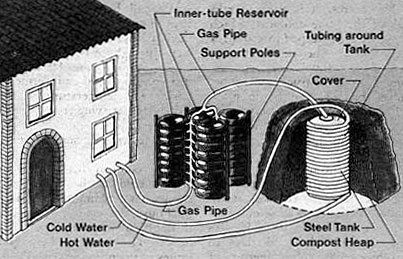
A simple diagram taken from this site….full of a lot of similar concepts for sustainable living.
Cut-out Pulls
Posted in Design Projects, Found Objects, Information, tagged bathroom, cabinets, cut-out pulls, details, holes, interiors, kitchen, patterns, utilitarian, value on September 23, 2013| Leave a Comment »
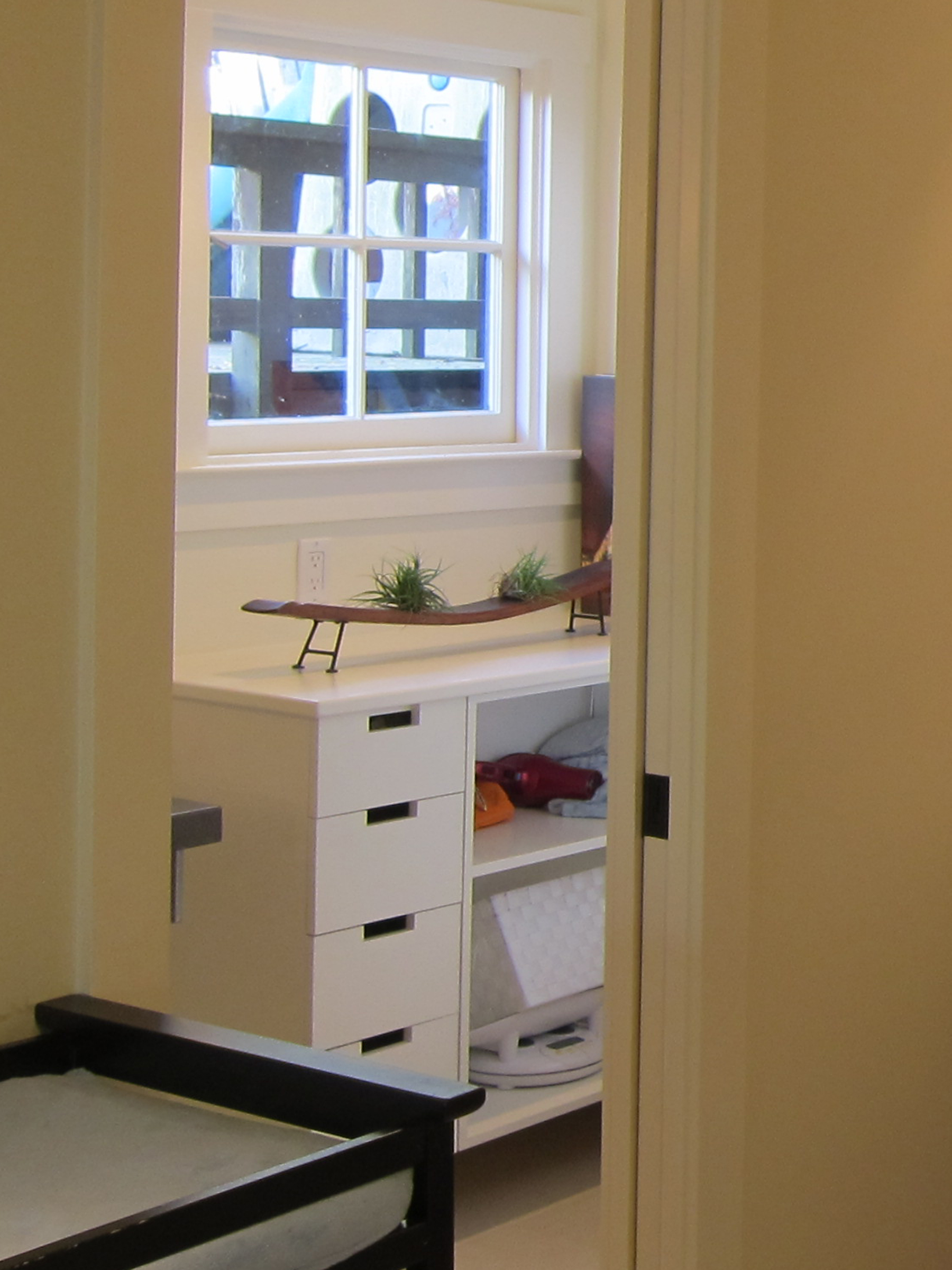
I have always liked this simple and affordable way to open cabinet drawers. This is a bathroom cabinet for a project here in Berkeley, CA.
Remodelista just posted a collection of some other nice examples (follow the link)
UL Listed Light Fixture Research
Posted in Design Projects, Information, tagged bathroom, code, lighting design on September 20, 2013| Leave a Comment »
My client would like a surface mounted track light over her bathroom vanity. I wanted certainty that code would allow a fixture rated only for dry locations in a bathroom. I found this article written by Mark Ode, a staff engineering associate at Underwriters Laboratory Inc on the website for the UL Company.
According to Mark, a dry location luminaire must be installed in a location that is not normally subjected to dampness but may be subjected to temporary dampness. With the proper ventilation, above a bathroom vanity fits this qualification. Inside the shower of course, where water can easily splash on a fixture, a fixture must be wet rated.
His article also explains the difference between wet, damp, and dry UL ratings, as well as a few less common ratings for light fixtures.
We are working hard here at deedsdesign
Posted in Information, tagged dog, isba on September 18, 2013| Leave a Comment »
Light Affair 2013 at the Pacific Energy Center San Francisco
Posted in Found Objects, Information, tagged energy efficiency, LED, lighting design on June 21, 2013| Leave a Comment »
Yesterday I attended this lighting showcase at the Pacific Energy Center. Most of the lights on display were LED technology. Here are a few highlights:
- Alva: a Berkeley company making affordable and elegant LED Wall Sconces with fabric or resin shades
- Shaper Lighting’s (Richmond, CA) new LED sconce comes in a variety of finishes
- Philips InteGrade LED Systems (cove/ under cabinet lighting)
- NUD Collection (Sweden) colorful fabric covered cords
http://www.nudnorthamerica.com
http://www.usa.lighting.philips.com/connect/LED_modules/inteGrade-LED-systems.wpd
http://www.cooperindustries.com/content/public/en/lighting/brands/shaper.html
Notes from LED Lighting Design Seminar
Posted in Information, tagged green, LED, LED light fixtures, lighting design on May 9, 2013| Leave a Comment »
The building energy code for California is getting stricter in January 2014 and the new rules have been published.
The real goal is for all new homes to be net zero energy by 2020.
One of the biggest hopes for energy savings is LED lights, and the CEC is cracking down on the industry demanding tighter tolerances and standards so that consumers can trust that they are getting the amount and color of light and the longevity that they are paying for.
I just got home from a presentation of some of the latest in LED lighting technology by Param Electric at Laner Electric Supply. I learned a few new tricks and I have some of their product recommendations to share.
1) You can add a current limiter to a track lighting system so that it can pass inspection in a kitchen where lights are required to be high efficacy
2) This one isn’t strictly for LED lights: MR16 fixtures need filters to diffuse the light and eliminate spotty wallwashing
3) The amazing new Cree “A Lamp” only dims to 40%. The new Title 24 for 2014 will require it to dim to 15%, so hopefully Cree will be able to make that happen. These sorts of LED bulbs that can screw into traditional sockets are a great and simple solution for energy savings without throwing out the whole fixture. Beware that overheating is a problem for these bulbs. Many cannot be installed in enclosed fixtures and some cannot be installed facing up. Most are directional, which can be a good thing, but doesn’t work so well in situations where you want light to shine up and down and all around.
3.5) I have used Cree recessed LED lights myself for at least the last 5 years with success, but learned from these specialists that Cree has good quality control and makes the lamps for many of the more high end LED fixture manufacturers. Cree itself keeps it simple and is able to produce basic recessed lights for a very affordable price. If you want something with more bells and whistles you will need to go to their competitors, Juno, Halo, Tech lighting and more. Many of their more expensive competitors are using Cree lamps in their own products.
4) Creative Lighting Systems makes a 2″ diameter recessed light that puts out 800 lumens for 11 watts. (Laner sells the whole package for about $220, the 4″ version is about $160) You can get lenses to change the lighting effect/ beam spread. According to Param, the color of CSL LED lights is not well controlled. You might get one where the color is off, otherwise they make great lights.
5) The color in Kelvins of LED light varies a lot. There has been poor regulation of this standard, but this is one of the things that the regulators are cracking down on. Soon the LED manufacturers will be held to a higher standard of accuracy. Read this for more info on color temperature in lighting.
6) Tech Lighting makes very high quality recessed lights and they are the only option if you need something that puts out a lot of lumens.
7) Diode LED makes very user-friendly strip lighting. A remote driver is required, but it can be far away and it isn’t very big. I have one of these strip lights over the door to my office. I love it so far…been about 3 years.
8) Max Light and Phillips Color Kinetics both make some good self-contained LED fixtures for undercabinet, closet, cove etc that do not need remote drivers.
9) RAB makes some great exterior LED fixtures. I can vouch for these myself.
A Review of Good House Cheap House
Posted in Found Objects, Information, tagged houses, utilitarian, value on March 26, 2013| Leave a Comment »
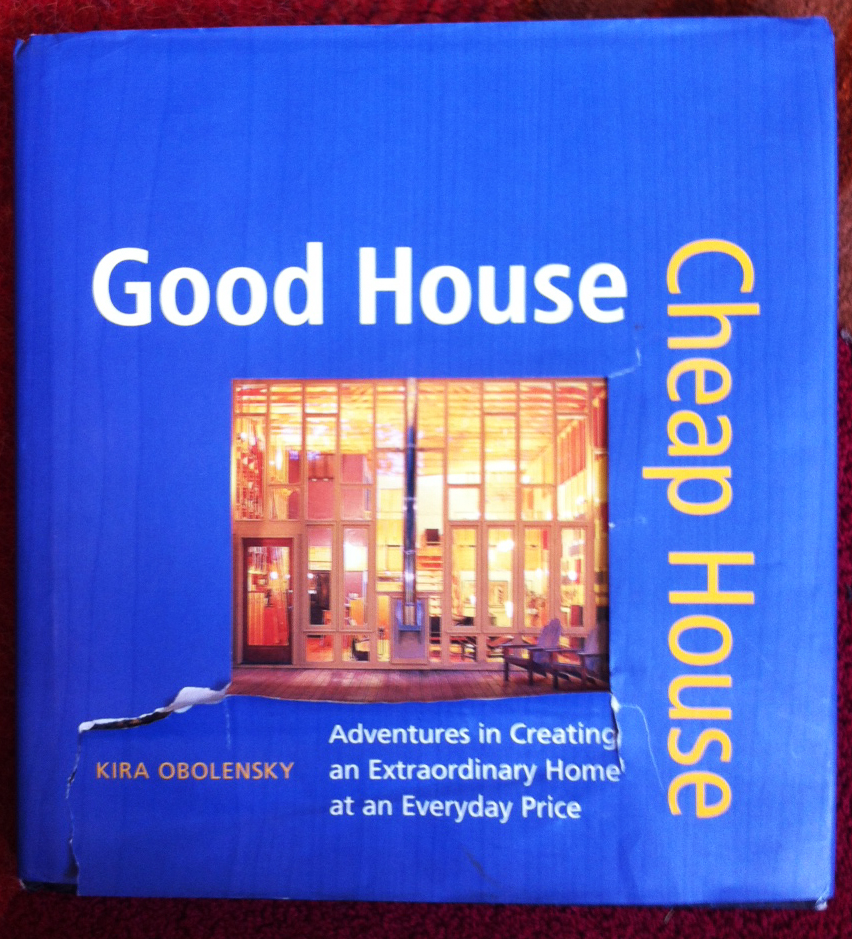
A friend recently recommended this book:
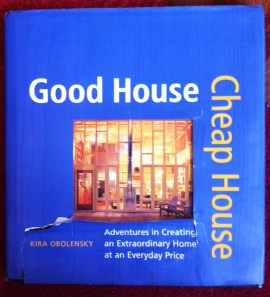
Good House Cheap House – An Adventure in Creating and Extraordinary Home at an Everyday Price by Kira Obolensky.
The main premise of the book is that you can build your dream house for below market rate prices through creativity, salvaged materials, and hard work. I will start by saying that I like the idea and I really like a most of the houses that she features. I also agree with Kira that the architect should not be eliminated as a cost saving measure. But now I will pick apart the strategies that she puts forward.
1) Salvaged materials – Generally this is not a viable or significant cost saving measure for most people. It is hard to find and store quantities of building materials. Using used windows doesn’t make sense in most climates because used windows are mostly not up to current energy efficiency standards. Using used framing materials often requires that they be re-certified to prove they can still perform. Additionally, Labor costs in the United States are usually a bigger share of the budget than the materials….so it doesn’t make sense from a financial standpoint to have paid labor removing nails and cleaning up salvaged materials. That said, if you do have a place to store materials out of the weather and access to good salvage yards, craigslist, and other places to buy used materials, money can be saved. There is often also character and charm in using salvaged materials..and of course it can be more environmentally sound. The same is true of saving parts of an old building rather than tearing it down and starting from scratch. Unfortunately, it is often cheaper to start from scratch.
2) Creativity – Kira shows many examples of ingenuity and unconventional uses of materials. Honestly, for most people with a hired contractor, I can’t imagine that this saves any money. The idea would have to be communicated from architect to client to builder, or from client to architect to builder or maybe just from client to builder and this often is a challenge. Frequently new creative ideas scare builders who have to put a price tag on things ahead of time. Many of the houses in Kira’s book are architects’ own houses. Its much easier to be creative on your own house. You can experiment and don’t have to spend time creating drawings, models, or other tools to convince the client of the idea. These architects probably did some of the building themselves, eliminating communication altogether. That said, much of the construction budget goes to finish materials. If you like the aesthetic of plywood as a finish floor or various sheet goods rather than tile for your shower and bathroom floor, curtains instead of doors for the shower and some closets, then you can save money.
It is wonderful to create something beautiful through creative use of basic materials. In my mind this is way cooler than making something beautiful by spending money on expensive tiles, carpets, and other architectural elements.
3) Hard work – In my opinion, this is the only sure winner, but it also has to be smart work. Experienced builders and architects and engineers are often more efficient and have tricks of the trade. Doing your own work, design or construction, can sometimes lead to disappointing results. The hardwork that makes the most sense in my opinion is spending the time to carefully select your architect and builder, spending the time to have your needs and desires and budget thought through, assisting the architect where possible and being available and giving schematic plans sufficient thought and consideration and getting preliminary pricing before moving along to the more detailed construction documents. It is often a good idea to pick a builder early on so the architect and builder can work together for an efficient collaboration. During construction there is plenty to do. Some builders are open to clients helping with the work, others typically bigger companies, want no part of this. I have had several projects where a small builder was happy to have the owner operate as a carpenter’s assistant. This is a great way to learn and get your hands dirty while having an expert on hand to guide the project. Home owners also frequently help with clean up and dump runs – labor intensive and low skilled parts of the job. Painting is often done by the home owners, but it is often more efficient to paint before finish electrical and plumbing, so it might be inconvenient for the contractor to wait while the homeowner does their own painting. The most important thing that a homeowner can do to make the job more efficient is to be available and spend the time to make decisions as quickly as possible. If every door knob has not been selected prior to construction with the architect, these things will have to be selected during construction. There are a lot of small decisions like this and it is crucial that they don’t cause delays. It is even more important that you don’t change your mind about certain decisions. changing things late in the game can be very expensive. Beyond making decisions, keeping your eye on things is always helpful. Even an untrained eye can detect issues and help things go more smoothly.
4) Simplicity – A cost saving measure that Kira does not mention is simplicity. For example: Most kitchens these days have recessed lights, under-cabinet lights and a decorative light in the middle of the room. If you have high enough ceilings to make it work, stick with one big light in the middle of the room. (if your ceilings are not high, you might not get enough light on the work surfaces.) Every switch and fixture costs money. Complicated roof lines can be very expensive in labor and materials.
5) Lifecycle costs – It is also important to consider the lifetime costs of the building. Incandescent bulbs might be cheaper, but LED bulbs will save you money in the long run. Durable materials will last longer. Money spent on extra insulation will usually save money down the road.
Interior Design and Color
Posted in Information, tagged color, interiors on March 23, 2013| Leave a Comment »
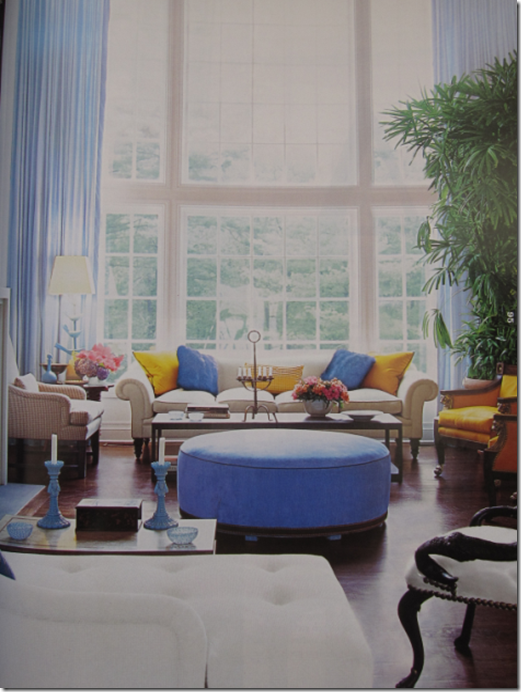
I’ve been following this blog of a color consultant & interior designer in part out of fascination with someone so different from myself, but also because she has some real tidbits of wisdom. Read the post linked above for her explanation of what is good about this room below.
The UK Bans Curvy Buildings and Glass Facades for New Schools
Posted in Information on November 27, 2012| 1 Comment »
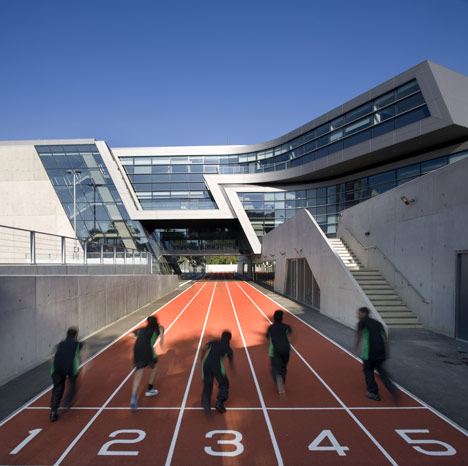
Dezeen magazine published this article about new policies in the UK mandating more utilitarian designs for new schools to be built in upcoming years. The Royal Institute of British Architects (RIBA) has responded to the new rules with concerns that many of the guidelines will yield short-term savings at the expense of long-term goals. I haven’t yet thoroughly read the regulations, but they do seem a bit overly rigid. The article contains a kind of depressing, misguided quote from education secretary Michael Gove: ”We won’t be getting Richard Rogers to design your school, we won’t be getting any award-winning architects to design it, because no one in this room is here to make architects richer.” As if there was a big problem of architects getting rich at the expense of the schools. They might be right to hirer fewer flashy star architects and I agree that schools, and buildings in general need to be sure to address practical concerns in addition to pushing the envelope with creativity, but it seems that they likely have gone too far with their guidelines.
Soft Thresholds and Introverted Ostentation
Posted in Information, tagged architecture for good on April 25, 2012| Leave a Comment »
My Dad just sent me this interview of Rahul Mehrotra, an architect practicing in Mumbai, India . He presents some of his ways of helping to connect society, “soften thresholds,” and bridge the gap between rich an poor in a very economically stratified place. In case you don’t have time to read the article, here is one excerpt from the interview that I found meaningful:
“This idea—how architecture can deepen social divides, depending on how it is used—is a major theme in your work, and obviously something you care deeply about. Do you ever have a private client who wants to build a very ostentatious house? How do you handle that?
I try to steer my wealthy clients toward “introverted worlds”—marble floors, nice fixtures. Ostentation on the inside rather than the outside. Polarization occurs when wealth is flaunted, and architecture can get co-opted in that process.”