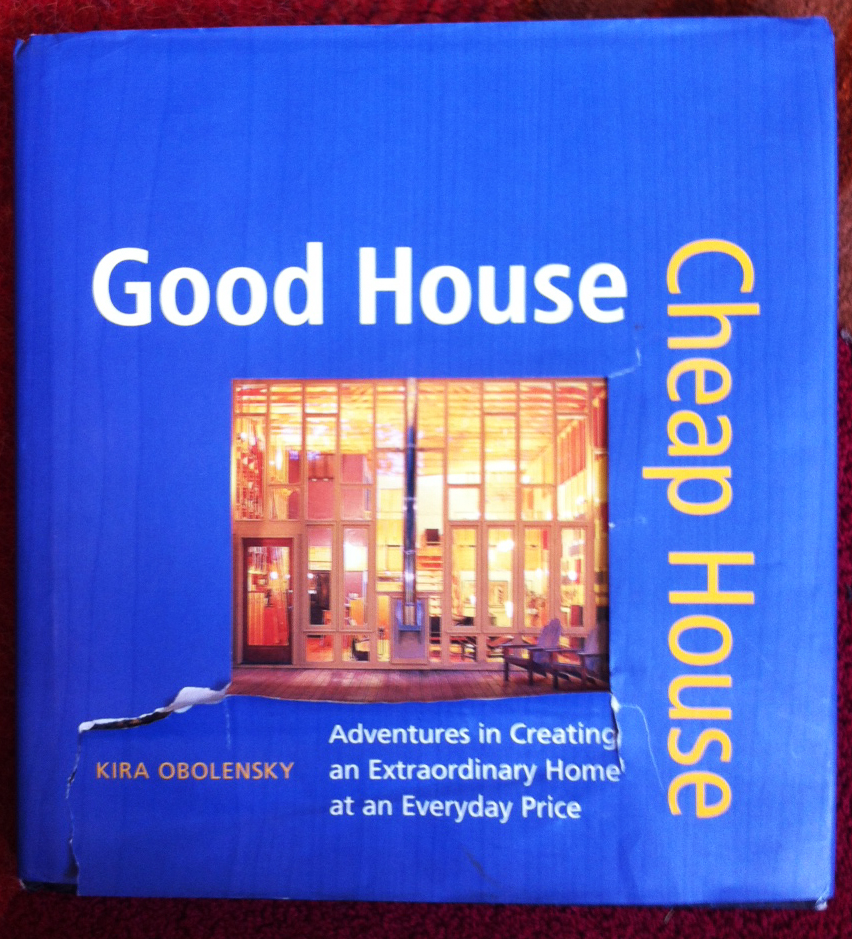
A friend recently recommended this book:
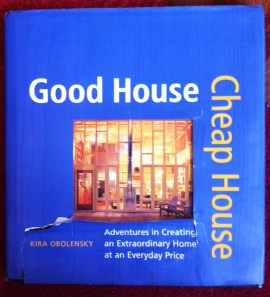
Good House Cheap House – An Adventure in Creating and Extraordinary Home at an Everyday Price by Kira Obolensky.
The main premise of the book is that you can build your dream house for below market rate prices through creativity, salvaged materials, and hard work. I will start by saying that I like the idea and I really like a most of the houses that she features. I also agree with Kira that the architect should not be eliminated as a cost saving measure. But now I will pick apart the strategies that she puts forward.
1) Salvaged materials – Generally this is not a viable or significant cost saving measure for most people. It is hard to find and store quantities of building materials. Using used windows doesn’t make sense in most climates because used windows are mostly not up to current energy efficiency standards. Using used framing materials often requires that they be re-certified to prove they can still perform. Additionally, Labor costs in the United States are usually a bigger share of the budget than the materials….so it doesn’t make sense from a financial standpoint to have paid labor removing nails and cleaning up salvaged materials. That said, if you do have a place to store materials out of the weather and access to good salvage yards, craigslist, and other places to buy used materials, money can be saved. There is often also character and charm in using salvaged materials..and of course it can be more environmentally sound. The same is true of saving parts of an old building rather than tearing it down and starting from scratch. Unfortunately, it is often cheaper to start from scratch.
2) Creativity – Kira shows many examples of ingenuity and unconventional uses of materials. Honestly, for most people with a hired contractor, I can’t imagine that this saves any money. The idea would have to be communicated from architect to client to builder, or from client to architect to builder or maybe just from client to builder and this often is a challenge. Frequently new creative ideas scare builders who have to put a price tag on things ahead of time. Many of the houses in Kira’s book are architects’ own houses. Its much easier to be creative on your own house. You can experiment and don’t have to spend time creating drawings, models, or other tools to convince the client of the idea. These architects probably did some of the building themselves, eliminating communication altogether. That said, much of the construction budget goes to finish materials. If you like the aesthetic of plywood as a finish floor or various sheet goods rather than tile for your shower and bathroom floor, curtains instead of doors for the shower and some closets, then you can save money.
It is wonderful to create something beautiful through creative use of basic materials. In my mind this is way cooler than making something beautiful by spending money on expensive tiles, carpets, and other architectural elements.
3) Hard work – In my opinion, this is the only sure winner, but it also has to be smart work. Experienced builders and architects and engineers are often more efficient and have tricks of the trade. Doing your own work, design or construction, can sometimes lead to disappointing results. The hardwork that makes the most sense in my opinion is spending the time to carefully select your architect and builder, spending the time to have your needs and desires and budget thought through, assisting the architect where possible and being available and giving schematic plans sufficient thought and consideration and getting preliminary pricing before moving along to the more detailed construction documents. It is often a good idea to pick a builder early on so the architect and builder can work together for an efficient collaboration. During construction there is plenty to do. Some builders are open to clients helping with the work, others typically bigger companies, want no part of this. I have had several projects where a small builder was happy to have the owner operate as a carpenter’s assistant. This is a great way to learn and get your hands dirty while having an expert on hand to guide the project. Home owners also frequently help with clean up and dump runs – labor intensive and low skilled parts of the job. Painting is often done by the home owners, but it is often more efficient to paint before finish electrical and plumbing, so it might be inconvenient for the contractor to wait while the homeowner does their own painting. The most important thing that a homeowner can do to make the job more efficient is to be available and spend the time to make decisions as quickly as possible. If every door knob has not been selected prior to construction with the architect, these things will have to be selected during construction. There are a lot of small decisions like this and it is crucial that they don’t cause delays. It is even more important that you don’t change your mind about certain decisions. changing things late in the game can be very expensive. Beyond making decisions, keeping your eye on things is always helpful. Even an untrained eye can detect issues and help things go more smoothly.
4) Simplicity – A cost saving measure that Kira does not mention is simplicity. For example: Most kitchens these days have recessed lights, under-cabinet lights and a decorative light in the middle of the room. If you have high enough ceilings to make it work, stick with one big light in the middle of the room. (if your ceilings are not high, you might not get enough light on the work surfaces.) Every switch and fixture costs money. Complicated roof lines can be very expensive in labor and materials.
5) Lifecycle costs – It is also important to consider the lifetime costs of the building. Incandescent bulbs might be cheaper, but LED bulbs will save you money in the long run. Durable materials will last longer. Money spent on extra insulation will usually save money down the road.
Read Full Post »






 deedsdesign